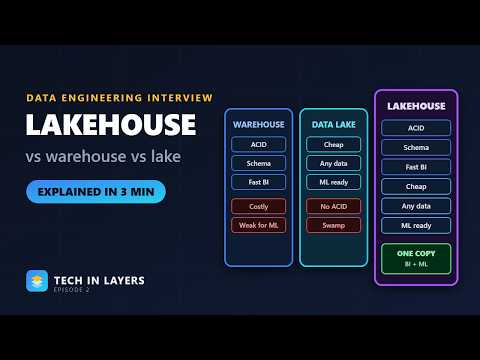
A follow-up to my Databricks architecture post. The next question I kept getting was "what actually is a lakehouse, and why not just use a warehouse?", so I drew that one too.
The crisp answer: a data warehouse gives you ACID transactions, enforced schemas and fast BI, but storage is proprietary and it struggles with raw files and machine learning. A data lake is cheap, open object storage that takes any data type, but with no transactions it slowly turns into a swamp. So most teams ran both and kept two copies in sync. A lakehouse puts an open table format like Delta Lake on the lake, so you get transactions, schema enforcement, governance and fast queries directly on cheap open storage: one copy of the data serving BI and machine learning.
Full animated walkthrough (under 3 min): https://youtu.be/-c09yVpUtAs
The whole series in order, starting from episode 1 (a new episode every day): https://www.youtube.com/watch?v=B5iHmoYgnqY&list=PLDB5WDkDOYF4
It is episode 2 of the same series, checked against the current docs. How do you explain the lakehouse in interviews? Would you add anything, like Iceberg or UniForm?