
Turn on suggestions
Auto-suggest helps you quickly narrow down your search results by suggesting possible matches as you type.
Showing results for
Data Engineering
Join discussions on data engineering best practices, architectures, and optimization strategies within the Databricks Community. Exchange insights and solutions with fellow data engineers.
Turn on suggestions
Auto-suggest helps you quickly narrow down your search results by suggesting possible matches as you type.
Showing results for
- Databricks Community
- Data Engineering
- Adding maven dependency to ETL pipeline
Options
- Subscribe to RSS Feed
- Mark Topic as New
- Mark Topic as Read
- Float this Topic for Current User
- Bookmark
- Subscribe
- Mute
- Printer Friendly Page

Options
- Mark as New
- Bookmark
- Subscribe
- Mute
- Subscribe to RSS Feed
- Permalink
- Report Inappropriate Content
11-17-2025 07:42 PM - edited 11-17-2025 07:48 PM
Hello guys,
I'm building ETL pipeline and need to access HANA data lake file system. In order to do that I need to have sap-hdlfs library in compute environment, library is available in maven repository.
My job will have multiple notebook task and ETL pipeline and from what I've researched, notebook tasks will use the same compute with the job, but ETL pipeline will have its own compute. And from UI, I cannot see where to add library into it.
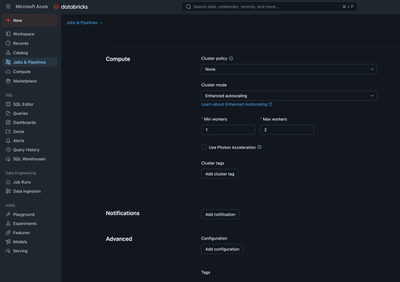
Could anyone confirm whether my understanding is correct and how to add library to ETL pipeline compute?
Thanks in advanced.


1 ACCEPTED SOLUTION
Accepted Solutions

Options
- Mark as New
- Bookmark
- Subscribe
- Mute
- Subscribe to RSS Feed
- Permalink
- Report Inappropriate Content
11-18-2025 06:05 PM
Hey @anhnnguyen, you can add libraries a few ways when building a notebook-based ETL pipeline:
The best practice, scalable approach to add libraries across multiple workloads or clusters is to use Policy-scoped libraries. Any compute that uses the cluster policy you define will add any dependencies to the cluster at runtime. Check this: Policy-scoped libraries
If you only need to add libraries to a single workload or cluster, use compute-scoped libraries.
Check this: Compute-scoped Libraries
5 REPLIES 5

Options
- Mark as New
- Bookmark
- Subscribe
- Mute
- Subscribe to RSS Feed
- Permalink
- Report Inappropriate Content
11-17-2025 10:33 PM
Hi @anhnnguyen ,
Unfortunately, Scala or Java libraries are not supported in lakeflow declarative pipeline (ETL Pipelines). So you need to use regular job if you want to install maven dependencies.
Manage Python dependencies for pipelines | Databricks on AWS


Options
- Mark as New
- Bookmark
- Subscribe
- Mute
- Subscribe to RSS Feed
- Permalink
- Report Inappropriate Content
11-18-2025 07:55 AM
DLT doesn’t have a UI for library installation, but you can:
Use libraries configuration in the pipeline JSON or YAML spec:
{
  "libraries": [
    {
      "maven": {
        "coordinates": "com.sap.hana.hadoop:sap-hdlfs:<version>"
      }
    }
  ]
}
Or, if you’re using Python, add the dependency in your requirements.txt and reference it in the pipeline settings.
Options
- Mark as New
- Bookmark
- Subscribe
- Mute
- Subscribe to RSS Feed
- Permalink
- Report Inappropriate Content
11-18-2025 06:03 PM
I tried and it does not work. After saving config, Databricks will revert it back.
The way seem possible is load library from init script but as @szymon_dybczak mentioned, it's not a good way since it will cause unexpected behavior
Options
- Mark as New
- Bookmark
- Subscribe
- Mute
- Subscribe to RSS Feed
- Permalink
- Report Inappropriate Content
11-18-2025 06:05 PM
Hey @anhnnguyen, you can add libraries a few ways when building a notebook-based ETL pipeline:
The best practice, scalable approach to add libraries across multiple workloads or clusters is to use Policy-scoped libraries. Any compute that uses the cluster policy you define will add any dependencies to the cluster at runtime. Check this: Policy-scoped libraries
If you only need to add libraries to a single workload or cluster, use compute-scoped libraries.
Check this: Compute-scoped Libraries
Options
- Mark as New
- Bookmark
- Subscribe
- Mute
- Subscribe to RSS Feed
- Permalink
- Report Inappropriate Content
11-18-2025 06:30 PM
thanks @XP, it worked like a charm
actually I did try with policy before but the one I tried is usage policy so that I could not find where to add library lol

Announcements


Related Content
- Lakeflow connect CT pipeline keeps running multiple connections in source in Data Engineering
- Streaming tables fail with DELTA_STREAMING_INCOMPATIBLE_SCHEMA_CHANGE_USE_SCHEMA_LOG after adding a in Data Engineering
- Oracle CDC Ingestion Pipeline - Schema Exploration finds 0 tables when DB_DOMAIN in Data Engineering
- Synced table pipeline fails with permission denied for database in Data Engineering
- INSERTS AND DELETES in a massive way for Lakeflow Spark Declarative Pipelines in Data Engineering