- Mark as New
- Bookmark
- Subscribe
- Mute
- Subscribe to RSS Feed
- Permalink
- Report Inappropriate Content
02-07-2022 08:28 AM
I trained a basic image classification model on MNIST using Tensorflow, logging the experiment run with MLflow.
Model: "my_sequential"
_________________________________________________________________
 Layer (type)                Output Shape              Param #
=================================================================
 reshape (Reshape)         (None, 28, 28, 1)         0

 conv2d (Conv2D)           (None, 26, 26, 32)        320

 max_pooling2d (MaxPooling  (None, 13, 13, 32)       0
 2D)

 flatten (Flatten)         (None, 5408)              0

 dense (Dense)            (None, 100)               540900

 dense_1 (Dense)            (None, 10)                1010

=================================================================
Total params: 542,230
Trainable params: 542,230
Non-trainable params: 0
_________________________________________________________________
with mlflow.start_run() as run:
run_id = run.info.run_id
mlflow.tensorflow.autolog()
model.fit(trainX, trainY,
validation_data = (testX, testY),
epochs = 2,
batch_size = 64)I then registered the model and enabled model serving.
When trying to send the JSON text through the browser in the form
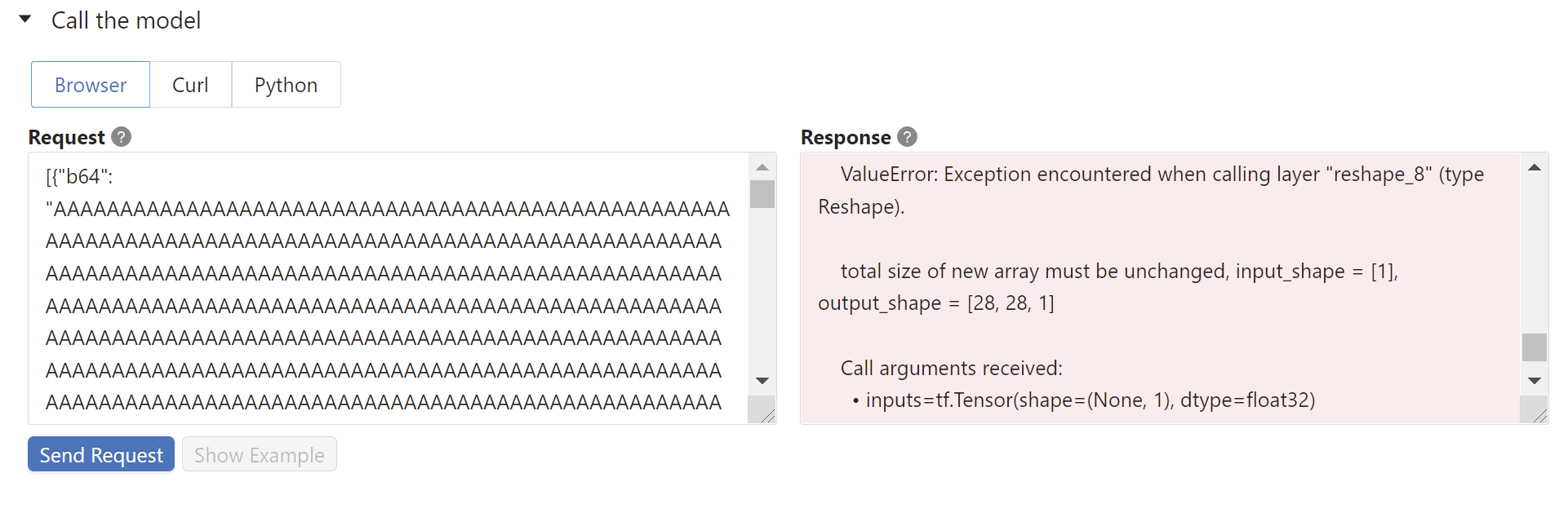
[{"b64": "AA...AA=="}]I'm getting errors like the following:
BAD_REQUEST: Encountered an unexpected error while evaluating the model. Verify that the serialized input Dataframe is compatible with the model for inference.

Traceback (most recent call last):
  File "/databricks/conda/envs/model-10/lib/python3.8/site-packages/mlflow/pyfunc/scoring_server/__init__.py", line 306, in transformation
    raw_predictions = model.predict(data)
  File "/databricks/conda/envs/model-10/lib/python3.8/site-packages/mlflow/pyfunc/__init__.py", line 605, in predict
    return self._model_impl.predict(data)
  File "/databricks/conda/envs/model-10/lib/python3.8/site-packages/mlflow/keras.py", line 475, in predict
    predicted = _predict(data)
  File "/databricks/conda/envs/model-10/lib/python3.8/site-packages/mlflow/keras.py", line 462, in _predict
    predicted = pd.DataFrame(self.keras_model.predict(data.values))
  File "/databricks/conda/envs/model-10/lib/python3.8/site-packages/keras/utils/traceback_utils.py", line 67, in error_handler
    raise e.with_traceback(filtered_tb) from None
  File "/databricks/conda/envs/model-10/lib/python3.8/site-packages/tensorflow/python/framework/func_graph.py", line 1147, in autograph_handler
    raise e.ag_error_metadata.to_exception(e)
ValueError: in user code:

    File "/databricks/conda/envs/model-10/lib/python3.8/site-packages/keras/engine/training.py", line 1801, in predict_function  *
        return step_function(self, iterator)
    File "/databricks/conda/envs/model-10/lib/python3.8/site-packages/keras/engine/training.py", line 1790, in step_function  **
        outputs = model.distribute_strategy.run(run_step, args=(data,))
    File "/databricks/conda/envs/model-10/lib/python3.8/site-packages/keras/engine/training.py", line 1783, in run_step  **
        outputs = model.predict_step(data)
    File "/databricks/conda/envs/model-10/lib/python3.8/site-packages/keras/engine/training.py", line 1751, in predict_step
        return self(x, training=False)
    File "/databricks/conda/envs/model-10/lib/python3.8/site-packages/keras/utils/traceback_utils.py", line 67, in error_handler
        raise e.with_traceback(filtered_tb) from None
    File "/databricks/conda/envs/model-10/lib/python3.8/site-packages/keras/layers/core/reshape.py", line 110, in _fix_unknown_dimension
        raise ValueError(msg)


ValueError: Exception encountered when calling layer "reshape" (type Reshape).

  total size of new array must be unchanged, input_shape = [1], output_shape = [28, 28, 1]

  Call arguments received:

   • inputs=tf.Tensor(shape=(None, 1), dtype=float32)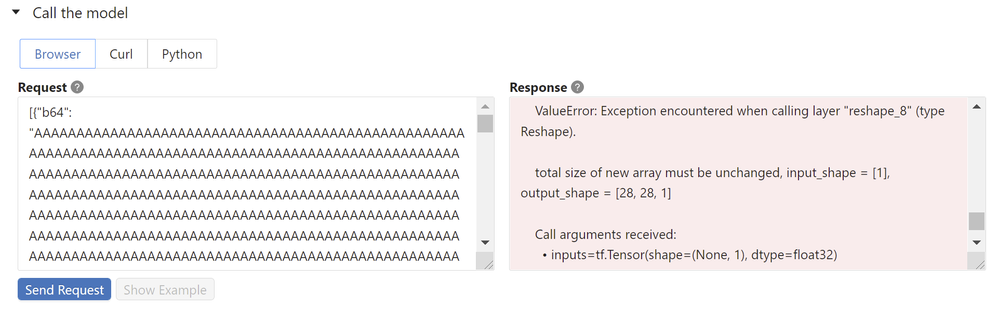
If I have an image with shape (28,28,1), called img, I am converting it to the required format like this
image_data = base64.b64encode(img)
json = {"b64": image_data.decode()}
My question has two parts:
- How do I adjust my model to handle the b64 encoded string and convert it back to a 28x28 image first?
- What is the exact JSON format I need to send the image data to the REST endpoint?
- Labels:
-
Image Data
-
MlFlow
- Mark as New
- Bookmark
- Subscribe
- Mute
- Subscribe to RSS Feed
- Permalink
- Report Inappropriate Content
02-18-2022 04:57 AM
Hi @Kaniz Fatma ,
Thanks for your answer!
My question is about this backend. You mean putting this line inside the predict() method?
When I'm defining a sequential model in TensorFlow, how do I incorporate what I want it to do to the input from a request?

- Mark as New
- Bookmark
- Subscribe
- Mute
- Subscribe to RSS Feed
- Permalink
- Report Inappropriate Content
03-15-2022 09:40 PM
@Anthony Gibbons may be this git should work with your use case - https://github.com/mlflow/mlflow/issues/1661