Healthcare organizations are increasingly adopting predictive AI systems to identify patient deterioration earlier to reduce ICU escalation risk and improve care response times. However, building real time healthcare AI systems at enterprise scale remains difficult because machine learning pipelines are often fragmented across separate systems for data engineering, feature engineering, model training and online serving. It creates operational complexity, inconsistent feature calculations, governance gaps and the most common ML failure (training serving skew).
Databricks Feature Store, powered by Lakebase provides a unified architecture for solving this challenge. Instead of maintaining disconnected offline and online feature pipelines, organizations can engineer, govern, publish and serve features directly from the Lakehouse platform with consistent feature definitions across training and inference workflows.
In the Patient Deterioration Risk Scoring case the architecture begins with operational healthcare systems generating continuous care signals. These include EHR and EMR platforms such as Epic or Cerner, laboratory systems, bedside monitoring devices, nursing notes, claims systems and telemetry. Data arrives through HL7, FHIR, REST APIs, CDC feeds and streaming device events. Using Lake flow Connect, healthcare events are continuously ingested into Delta Lake using bronze, silver and gold medallion pipelines.
The Lakehouse becomes the unified healthcare intelligence foundation. Delta Lake stores longitudinal patient records, vitals, labs, medications, utilization history, procedures, and operational healthcare events with ACID guarantees, schema evolution, and time travel support. Its important for healthcare AI because feature correctness depends heavily on temporal accuracy. Training datasets must reflect the exact state of patient information available at the moment a care event occurred. Databricks Feature Store supports point-in-time feature joins specifically to address this requirement and reduce data leakage during model training.
Feature engineering becomes a reusable enterprise capability instead of isolated development. Care and data science teams can define standardized features such as six hour heart rate trends, systolic pressure variance, oxygen saturation decline, utilization frequency, SOFA components and Charlson Comorbidity scores. These features are registered centrally in Unity Catalog backed tables enabling discoverability, governance, lineage tracking and reuse across multiple initiatives. Databricks Feature Store acts as the central registry for these reusable features.
Databricks Online Feature Stores are built on Lake base infrastructure and provide low latency feature retrieval for operational AI systems. Organizations can publish Unity Catalog feature tables into online stores allowing the latest feature values to be served to real time applications and models.
For patient deterioration risk scoring, it enabled continuously refreshed patient intelligence during inference. As new vitals, labs or encounter events arrive, online feature stores synchronize the latest feature values for immediate consumption. Care alerting systems, operational dashboards and escalation workflows can then retrieve features with sub 10ms latency while remaining consistent with offline training data.
Models trained using Databricks Feature Engineering automatically track lineage to the features used during training. The same feature transformations used during training are also applied consistently during real time scoring. The architecture introduces a mature feature lifecycle model. Care Teams discover candidate features from healthcare datasets, define metadata and freshness requirements, build transformation pipelines, publish features into online stores, operationalize them through Serving endpoints, continuously monitor feature quality and drift and evolve features safely through versioning and governance controls.
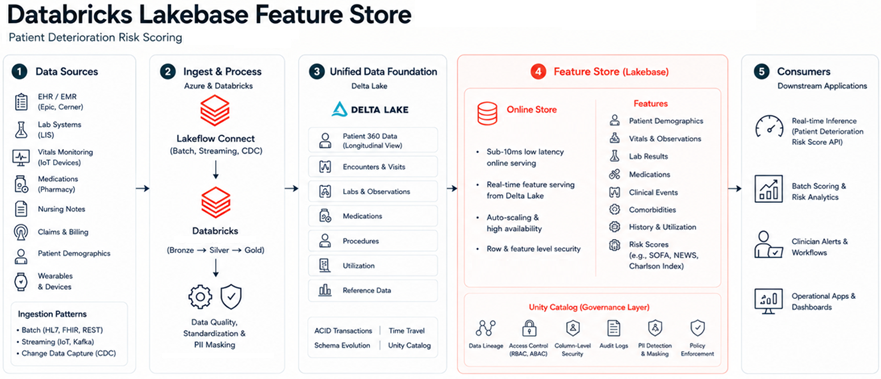
Unity Catalog provides centralized access control, lineage, auditability, PII masking and policy enforcement across healthcare data and feature assets. Online feature stores inherit governance controls through underlying Lake base infrastructure. Its essential for regulated healthcare environments where explainability, security and traceability are mandatory requirements.
Healthcare enterprises can operationalize governed real time care intelligence directly from the Lakehouse enabling scalable, low-latency, and production-ready AI for patient care instead of managing fragmented pipelines. The broader significance of this architecture is that healthcare organizations no longer need separate platforms for analytics, machine learning, and operational serving. Databricks Feature Store with Lake base enables all three capabilities to operate on a unified data intelligence foundation. Real-time AI becomes operationally scalable, governance becomes centralized, feature reuse becomes enterprise-wide, and healthcare intelligence becomes directly embedded into care workflows