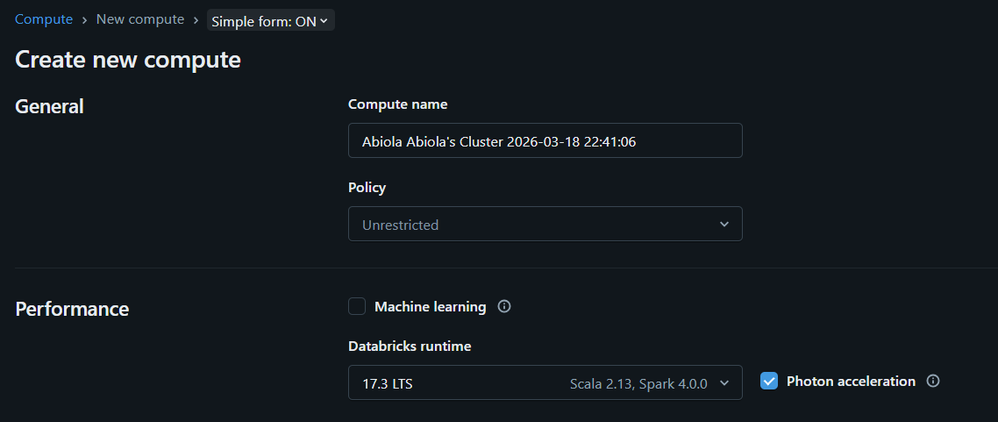
If you’ve been working with newer clusters in Databricks, chances are you’ve noticed the term Photon appearing in your cluster configuration or query profiles. At first glance, it might look like just another performance feature—but in reality, Photon represents a fundamental shift in how queries are executed.
This isn’t just an incremental improvement. Photon is a completely redesigned execution engine, built from the ground up in C++, and it’s one of the key reasons why many workloads are now running 2x–5x faster without any code changes.
What Exactly is Photon?
Photon is a high-performance vectorized query engine designed to accelerate SQL and DataFrame workloads in Databricks.
Traditionally, Apache Spark (Apache Spark) executes queries using a JVM-based engine. While powerful, it has limitations when it comes to fully utilizing modern CPU capabilities.
Photon changes that by:
- Moving execution closer to native hardware (C++)
- Leveraging modern CPU optimizations
- Reducing overhead from the JVM layer
The result? Faster queries, lower latency, and better resource utilization.
Why Photon Feels So Fast
Let’s break down what’s really happening under the hood.
- Vectorized Execution (The Real Game-Changer)
Traditional execution processes data row by row:
Row 1 → Process Row 2 → Process Row 3 → Process
Photon flips this model to columnar batch processing:
Batch of 1000 values → Process together
Why this matters:
- Better CPU cache utilization
- Fewer function calls
- Exploits SIMD (Single Instruction, Multiple Data)
In simple terms: the CPU does more work per cycle
This is where a huge chunk of that 3x performance gain comes from.
- Native C++ Engine (Goodbye JVM Bottlenecks)
Photon is written in C++ instead of Java/Scala, which allows it to:
- Eliminate JVM overhead
- Reduce garbage collection pauses
- Execute closer to the hardware
What this means for you:
- Faster joins
- Faster aggregations
- Lower query latency
This is especially noticeable in:
- Large aggregations
- Complex joins
- BI dashboard queries
- Seamless Integration with Spark (No Code Changes Required)
One of the most powerful aspects of Photon is:
You don’t need to rewrite anything
It works with:
- Spark SQL
- DataFrame APIs
- Existing pipelines
So your existing code like:
SELECT region, SUM(sales) FROM catalog.schema.sales_table GROUP BY region
…automatically benefits from Photon when enabled.
This makes it:
- Developer-friendly
- Low-risk to adopt
- Instant performance upgrade
- Deep Optimization for Delta Lake
Photon is tightly integrated with Delta Lake, which is the backbone of the Lakehouse architecture.
Why this matters:
Photon understands:
- Delta file formats
- Metadata
- Statistics
- Data skipping
So it can:
- Read less data
- Skip unnecessary files
- Optimize I/O operations
Result: Blazing-fast Lakehouse queries