Hi @jroots,
On some research, I can see that the YAML in the docs is doing what window measures are defined to do, but the wording is perhaps a bit misleading. In the below example you shared,
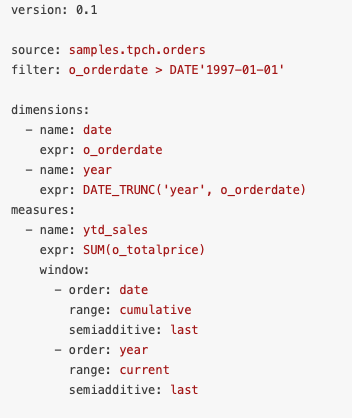
range: current means "rows whose order value equals the current row’s value,"...
and semiadditive: last says "when that order dimension (here year and date) isn’t grouped, use the last value in that window.”
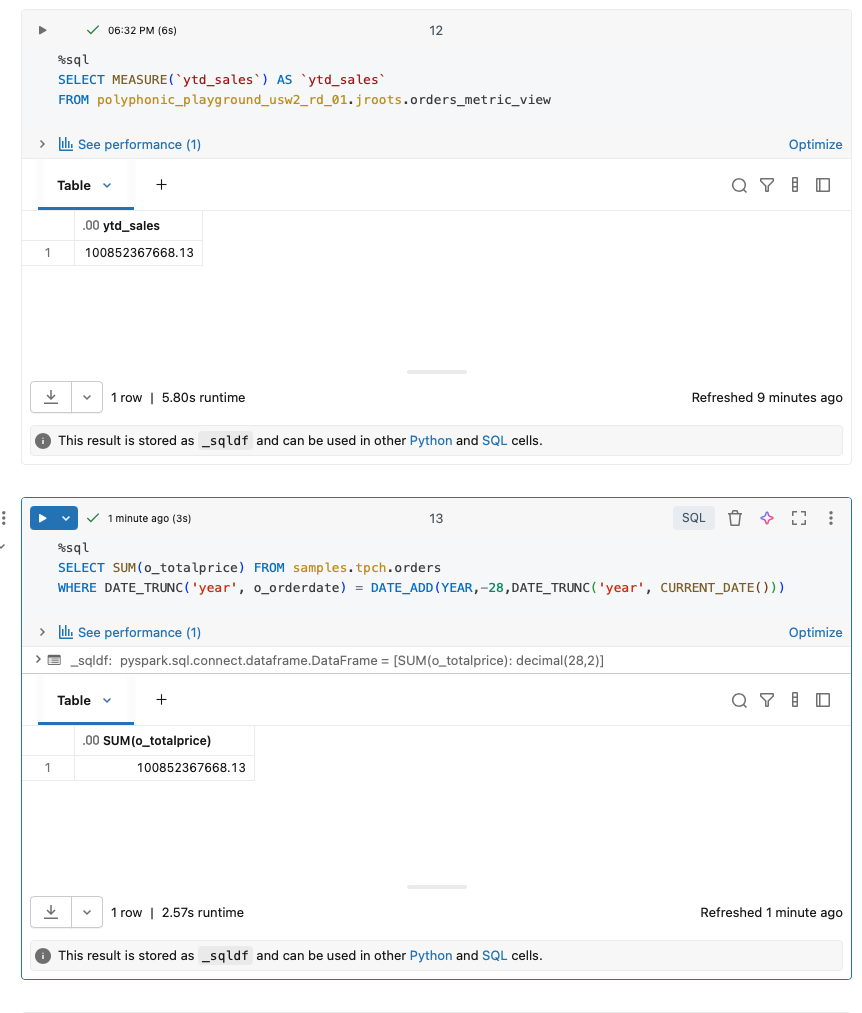
When you query MEASURE(ytd_sales) without grouping by year or date, the engine selects the last date from the last year in the data and returns that year-to-date total. If no data for the actual calendar year contains current_date(), it naturally falls back to the most recent year that does have rows.
To get "YTD for the calendar year containing current_date()," you currently have to push the notion of "current year" into the query instead of the metric view definition, for example, by filtering on DATE_TRUNC('year', date) = DATE_TRUNC('year', CURRENT_DATE()). Putting CURRENT_DATE() / CURRENT_TIMESTAMP() directly in the metric view YAML makes the definition invoker-dependent, which is why materialized metric views then stop working (they can’t be reused if the definition depends on evaluation time).
Does this give you a direction?
If this answer resolves your question, could you mark it as “Accept as Solution”? That helps other users quickly find the correct fix.
Regards,
Ashwin | Delivery Solution Architect @ Databricks
Helping you build and scale the Data Intelligence Platform.
***Opinions are my own***






![Community [Industry BrickTalk #3]: Scaling Video Intelligence Using AI on Databricks](/t5/image/serverpage/image-id/25651iB18C1F3FD2C2DA5A/image-size/large?v=v2&px=999)